
12th November is International CJD Awareness Day. This is a day when members of the prion disease community around the world come together to raise awareness of CJD and prion diseases, highlight the available support and recognise ongoing research.
We encourage our UK community members to share the below messages and graphics with their own social media networks, or share our Facebook and X (Formerly twitter) social media posts on the day. Don’t forget to add the the following hashtags to any posts:
#CJDAwareness
#PrionDiseaseAwareness
Click HERE to download a folder containing all our International Awareness Day graphic resources. A pdf of this post is AVAILABLE HERE if you would find it helpful to copy and paste our suggested post and alt text suggestions.
CJD Support Network suggested text/graphics for social media posts.
We have included some post text and ‘Alt Text’ suggestions. Most social media allows you to add an Alt Text description of an image for anyone unable to see the images who may be using a screen reader. These are overviews of what information is contained in each image. These are not required by any platform, but are there to be make your posts as accessible as possible to all, if you would like to use them.
We have also included some suggestions for the actual text of the post. These are just there to help, and you can of course personalise your posts. Your social media is your own and we welcome you raising awareness in your own ways, too.
Please feel free to tag us or link to us.
Facebook: @CJDSupport
X: @supportcjd
Infographic
This infographic was developed and provided by the CJD International Support Alliance click HERE to download. It could be the basis of a post explaining what CJD is with some level of accessible detail.

Possible Alt Text
The graphic shows an umbrella to demonstrate how there are three different types of CJD, all included under the umbrella term ‘CJD’. The graphic goes on to have text that says
Prion Diseases are, rapidly progressive and always fatal neurological disease
Sporadic CJD (sCJD) has no known cause and occurs randomly with a lifetime risk of 1:6,000.
sCJD accounts for approximately 85%-90% of all cases of prion disease.
Atypical forms of sCJD account for less than 1% of all sporadic cases.
These include Variably Protease Sensitive Prionopathy (VPSPr) and Sporadic Fatal Insomnia (sFI).
Genetic prion disease accounts for approximately 10-15% of all prion disease cases.
Genetic prion disease includes Genetic CJD (gCJD), Gerstmann–Sträussler–Scheinker disease (GSS) and Fatal Familial Insomnia (FFI).
DNA can be tested to identify if an individual carries a mutation for prion disease.
The vast majority have an autosomal dominant pattern – if one parent carries a mutation for prion disease there is a 50-50 chance for each child to inherit the gene.
Acquired prion disease is the rarest cause representing less than 1% of all prion diseases.
Iatrogenic or medically acquired CJD from contaminated surgical instruments, corneal transplant, dura mater graft, and human pituitary hormone treatment for infertility and short statue.
Variant CJD (vCJD) was acquired from exposure to BSE through consumption of contaminated beef or blood plasma transfusion.
The graphic shows it was produced by the CJD International Support Alliance, which provides support for patients and their families affected by prion disease globally. Their website is www.cjdisa.com
The first four images can be posted as one post or individually.
Suggested Post 1:
Possible Alt text:
The CJD Support Network logo is shown and then the text ‘Did you know today, November 12th is International Creutzfeldt-Jakob Disease (CJD) Awareness Day)’. The image shows the hashtags #PrionDiseaseAwareness and #CJDAwareness. It shows the website www.cjdsupport.co.uk and lists the charity number as 1097173.
Possible post text:
Today is International CJD Awareness Day (12th November) CJD is a prion disease. I am raising awareness because [insert information about your connection to prion disease e.g. My family are affected by the prion disease GSS // I lost my mum to sporadic CJD etc.]
This post could also include images and the stories from people affected by CJD included below, or stand alone.
Suggested Post 2:
Possible Alt text:
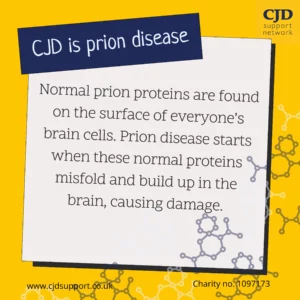
The CJD Support Network logo is shown and then the text ‘CJD is a prion disease. Normal prion proteins are found on the surface of everyone’s brain cells. Prion disease starts when these normal proteins misfold and build up in the brain, causing damage.’ It shows the website www.cjdsupport.co.uk and lists the charity number as 1097173.

Possible Alt text:
The CJD Support Network logo is shown and then the text ‘CJD and prion diseases are rare, progressive and currently always fatal, with no existing treatments. The initial symptoms vary depending on the area of the brain affected first, but can include mood changes, sleep disturbance, dizziness, unsteadiness and forgetfulness. Sporadic CJD is the most common prion disease. It progresses rapidly and seems to happen at random, usually between ages 45-75. Visit www.cjdsupport.co.uk/fact-sheets for more info on sporadic, inherited and acquired forms of prion disease.’. It shows the website www.cjdsupport.co.uk and lists the charity number as 1097173.
Possible Alt text:
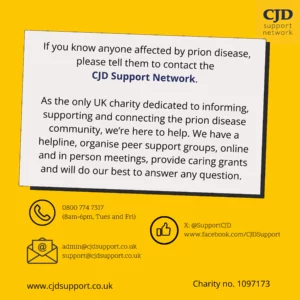
The CJD Support Network logo is shown and then the text ‘If you know anyone affected by prion disease, please tell them to contact the CJD Support Network. As the only UK charity dedicated to informing, supporting and connecting the prion disease community, we’re here to help. We have a helpline, organise peer support groups, online and in person meetings, provide caring grants and will do our best to answer any questions. The phone number is 08007747137 and is open 08:30 to 15:30 on Tuesdays and 11:00 to 18:00 Wednesday and Thursdays. An email address is given: support@cjdsupport.co.uk and facebook address is www.facebook.com/CJDSupport.’ The image shows the hashtags #PrionDiseaseAwareness and #CJDAwareness. It shows the website www.cjdsupport.co.uk and lists the charity number as 1097173.
Possible post text:
What do you know about Creutzfeldt–Jakob disease (CJD)/Prion diseases?
Normal prion proteins are found on the surface of everyone’s brain cells. Prion disease starts when these normal proteins misfold and build up in the brain, causing damage.
CJD and prion diseases are rare, progressive and currently always fatal, with no existing treatments. The initial symptoms vary depending on the area of the brain affected first, but can include mood changes, sleep disturbance, dizziness, unsteadiness, and forgetfulness.
Prion diseases can be sporadic, inherited, and in specific circumstances have been acquired.
Sporadic CJD is the most common prion disease, it progresses rapidly and seems to happen at random, usually between ages 45-75. Visit www.cjdsupport.co.uk/fact-sheets for more info on different forms of prion disease.
This post could also include posts from people affected by CJD below, or stand alone.
Suggested Post 3:

Possible Alt text:
The CJD Support Network logo is shown as well as a photo of a man looking out at the viewer. This is Professor Simon Mead. He is a neurologist and the Clinical Lead at the UK National Prion Clinic. He says, “We have entered a new era when it is possible to test the effectiveness of treatments targeting prion protein, which gets at the root causes of CJD.” The image shows the website www.cjdsupport.co.uk and lists the charity number as 1097173.
Possible Alt text:
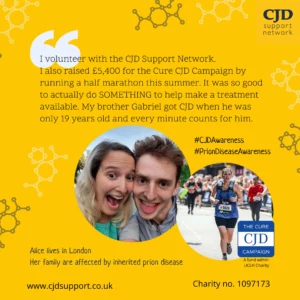
The CJD Support Network logo is shown as well as a photo of a grinning brother and sister. Another photos shows the same woman running in a half marathon. The woman is Alice, who lives in London, and the man is her brother, Gabriel. Their family is affected by Inherited Prion Disease. She says, “I volunteer with the CJD Support Network. I also raised £5,400 for the Cure CJD Campaign by running a half marathon this summer. It was so good to actually do SOMETHING to help make a treatment available. My brother Gabriel got CJD when he was only 19 years old and every minute counts for him. The image shows the website www.cjdsupport.co.uk and lists the charity number as 1097173.
Possible Post text:
Today is International CJD Awareness Day (12th November). A day dedicated to raising awareness of CJD and other prion diseases. At present there are no approved prion disease treatments and the CJD Support Network is here for those who are currently being affected. But international researchers like www.gatebio.com @SangamoTx @prionalliance @ionispharma @MRC_Prion give us hope for the future*. For updates on prion protein targeting treatments being assessed or considered, visit: cjdisa.com/research/clinical-trials/
One potential treatment developed by @MRC_Prion is an antibody called PRN100, along with the @CureCJDCampaign, they are trying to raise funds for an organised clinical trial to test this treatment. Visit their website here to learn more www.curecjd.org
The International CJD Support Alliance brings together patient associations in different countries under one umbrella, they post helpful updates about treatment related research on their website: https://cjdisa.com
Testimonies
These can be used in addition to any of the above images, or by themselves. We are so grateful to everyone who has allowed us to share their stories. If you would like to share yours, please email us at support@cjdsupport.co.uk .
Possible Alt text:
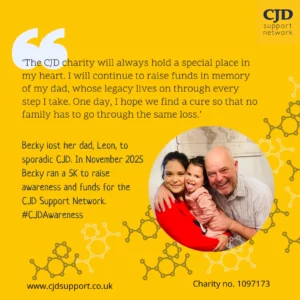
The CJD Support Network logo is shown. A group of three happy, laughing people smile out at the camera. A woman wearing red is Becky. A man wearing a pale shirt is Leon. There is also a laughing babe. A quote from Becky is shown. Becky lost her father, Leon, to Sporadic CJD. “The CJD charity will always hold a special place in my heart. I will continue to raise funds in memory of my dad, whose legacy lives on through every step I take. One day, I hope we find a cure so that no family has to go through the same loss. The image shows the hashtag #CJDAwareness. It shows the website www.cjdsupport.co.uk and lists the charity number as 1097173.

Possible Alt text:
The CJD Support Network logo is shown. A brightly smiling woman, Hannah, smiles at the camera. Behind her a person is holding a shaver to her head, and she has just had a very close shave. Her hair is gone. A quote from Hannah is shown. “Having lost mum so quickly and unexpectedly in January 2024 to sporadic CJD, I knew I had to do something to help others affected by this awful disease. The amount I raised is truly overwhelming and knowing just what a difference this can make to families affected by CJD by raising awareness and funding research into finding an earlier more reliable diagnosis and hopefully we can find a cure soon”. The image shows the hashtags #PrionDiseaseAwareness and #CJDAwareness. It shows the website www.cjdsupport.co.uk and lists the charity number as 1097173.

Possible Alt text:
The CJD Support Network logo is shown. A group of smiling people wearing bright yellow CJD Support Network t shirts stand behind a bar. A quote from Ian from South Wales is shown. Ian lost his wife Darlene to Sporadic CJD in 2023. “Being in touch with the CJD Support Network has supported me through the most traumatic period of my life. I’m now involved in fundraising and promoting understanding of prion disease. This has helped me through my own, and my family’s continuing journey”. The image shows the hashtags and #CJDAwareness. It shows the website www.cjdsupport.co.uk and lists the charity number as 1097173.
Possible Alt text:
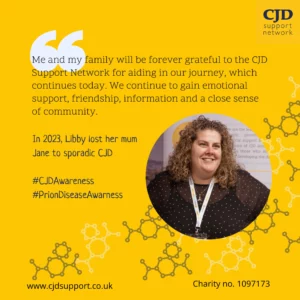
The CJD Support Network logo is shown. A woman smiles out. This is Libby who lost her mum Jane to Sporadic CJD in 2023. There is a quote from her saying “Me and my family will be forever grateful to the CJD Support Network for aiding in our journey, which continues today. We continue to gain emotional support, friendship, information and a close sense of community”. The image shows the hashtags #PrionDiseaseAwareness and #CJDAwareness. It shows the website www.cjdsupport.co.uk and lists the charity number as 1097173.

Possible Alt text:
The CJD Support Network logo is shown and a couple smiles out at the camera. They have two spaniel dogs with them. It’s a very cosy image. This is Dave and his partner. Dave lives in Yorkshire and is at increased risk of Iatrogenic CJD. He says, “Ive contacted the CJD Support Network helpline when feeling really low. They are always there for you with support, they have been so good for me. I’ve also attended online events and had contact with people on the Facebook group. They know what you’re feeling and understand waht you’ve been through. Over recent years I have been working hard to raise money and awareness”. The image shows the hashtags #PrionDiseaseAwareness and #CJDAwareness. It includes a QR code to hear more about Dave’s experiences at https://cjdsupport.co.uk/real-stories/ . The image shows the website www.cjdsupport.co.uk and lists the charity number as 1097173.
Possible post text:
The CJD Support Network is a resource for people affected by and at risk of all forms of prion disease in the UK. They offer telephone support, peer support groups, online and in person meetings, caring grants and answer questions: www.cjdsupport.co.uk
The CJD Support Network is the only UK charity dedicated to supporting the prion disease community. They understand and are there to listen. Contact via email on support@cjdsupport.co.uk or call our helpline on 0800 774 7317 (8.30am-3.30pm Tuesday & 11am-6pm Wednesday and Thursday).
To read about real world experiences of CJD and prion disease, visit: www.cjdsupport.co.uk/share-your-story/
Click HERE to download a folder containing all our International Awareness Day graphic resources.
*@handles taken from X (formerly twitter) If using this text across other social media platforms, it may be necessary to edit handles referenced here.
We have also included images of challenge event items, a yellow CJD ribbon and an email footer in the downloadable folder.