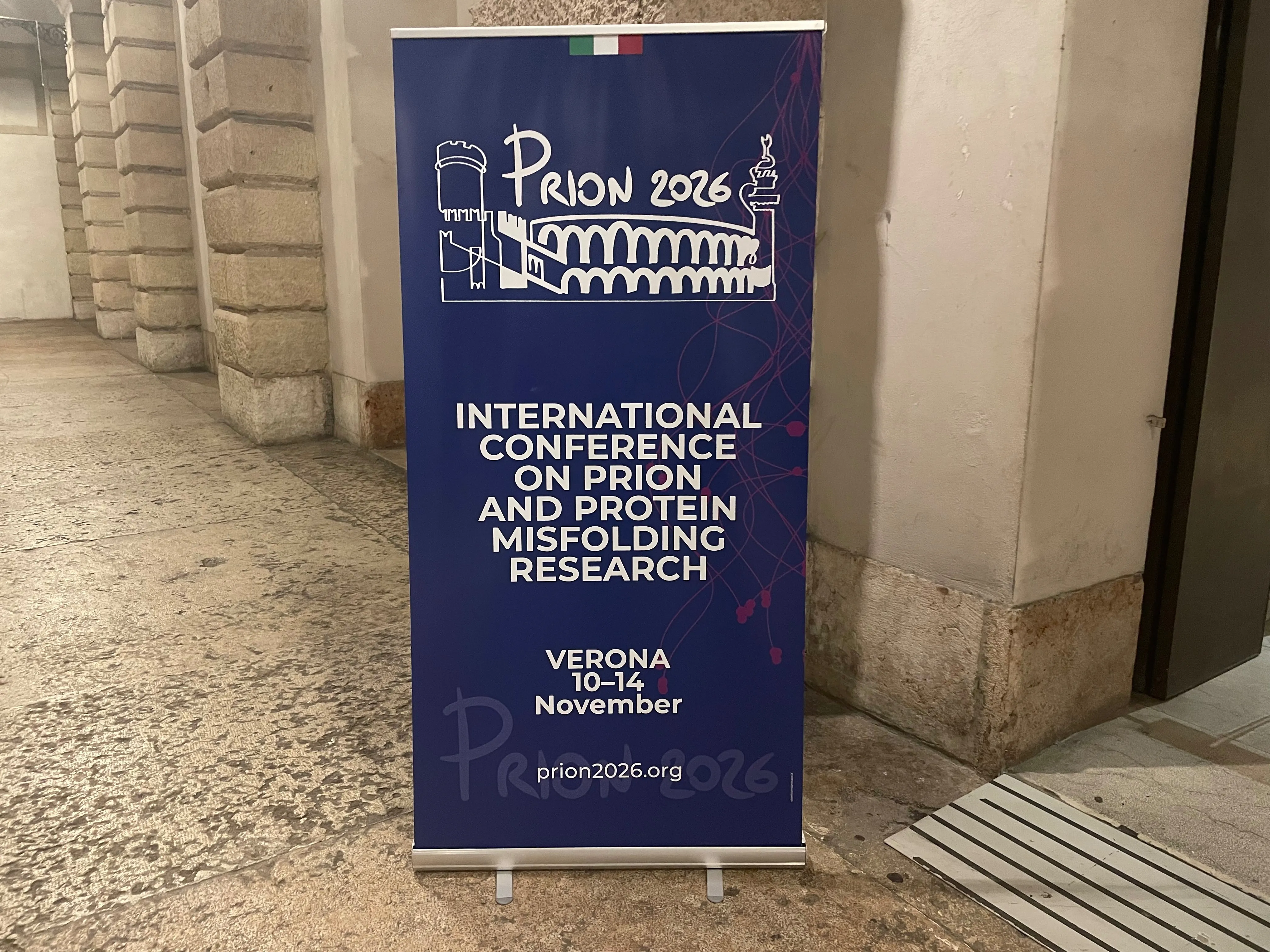

An update from Day Two of Prion 2026 from Catherine, our National Coordinator:
A grey but initially dry day in Verona meant a short but exceptional walk to work past the Arena and other beautiful buildings before arriving at the venue. I was pleased to bump into someone I met last night, and also Dr Tze How Mok from the National Prion Unit in the auditorium. The usual search for wifi passwords and pens soon settled into an attentive audience.
Welcomes
We were welcomed to the conference by both representatives of the Veneto region, and by the organising committee including three universities: Verona, Trento and SISSA, the International School for Advanced Studies which is an international, state-supported, post-graduate-education and research institute in Trieste, Italy.
Dr Annamaria Molino, a medical doctor and a Councillor in Verona welcomed us to the City. She celebrated researchers, and stressed that behind all the research are people – families – who require “support and understanding” and that researchers and clinicians must “keep people at the centre of our actions”. This is an essential part of what the CJD Support Network is here to do, so it was very positive to hear this message so early in the day. Dr Molino went on to emphasise the importance of inclusion, equality of life, searching for new ideas, and developing cooperation. The room appeared very glad to applaud.
Professor Silvia Savazzi, Professor of Physiology at the University of Verona, followed and represented the Rector of the University of Verona in welcoming us all. She recognised the 30 years of prion research by Prof. Gianluigi Zanusso (University of Verona and member of the organising committee). Prof. Savazzi also stressed that patients are at the centre of all research. She went on to explain that for her, research starts with basic science, and to perfect this curiosity driven research must be encouraged and supported. University of Verona is offering support to young researchers by supporting exploring ideas without an end function necessarily known at the start. She offered good wishes to all the early career researchers attending, and encouraged them to engage in discussion and to challenge even the senior researchers in attendance, as this is how new ideas and progress can happen. Again, a warmly supported notion in the room.
Remembering Byron Caughey
Dr Caughey was a central figure in prion disease research and understanding who sadly passed away in February 2026. Eric Minikel’s moving and thorough piece on Dr Caughey and his work can be read here for more understanding of his contribution to the area. To honour Dr Caughey’s memory, 15 conference Fellowships were announced. All will be awarded to young researchers presenting posters or making other contributions to the conference. 5 will be in the sum of $1,000 to the best poster presentations, with the remaining 10 being funded by the CJD Foundation with $500 going to each of the ten best contributions.
Conference posters provide a brief summary of individual projects and work being carried out to improve understanding, care and support for people affected by prion diseases. They are often a starting point for young researchers to present at conferences such as this.
Main Sessions
Today the focus was on prion disease in animals alongside consideration of how animals have contributed to research, and how disease can cross to humans. Please be aware that my understanding below is those of a non-scientist, although I have tried to reflect the sessions as well as I can. This is not a reflection of very talk, I only wish I could keep up with them all!
The first keynote talk of the day was on Bank Voles, a topic entirely new to me. Umberto Agrimi described how the bank vole has proven invaluable to our understanding of prions. Just one example is that this tiny rodent led to our understanding that Gerstmann–Sträussler–Scheinker is in fact a prion disease rather than a non-transmissible proteinopathy.
I was amazed to hear that our understanding of prion diseases in animals now extends to camel prion disease. Obaid Allah Ben Abid shared his work studying 61 herds of camels in two regions of Tunisia: Kebili and Tataouine. The dromedaries do not have any contact with cattle, so there is work to be done to understand the source of their form of prion disease. This research tested two camels whose herders believed they had diseases referred to as Dehba, Rih and Jnoun. In each case the camel’s case of prion disease was confirmed. This is important as it demonstrates that local knowledge has potential value in monitoring disease and transmission dynamics.
Another keynote was simply titled ‘The History of BSE‘. Delivered by Dr Angel Ortiz, this covered the topic beyond the United Kingdom context, so was valuable in understanding how this had affected other countries. The history went back to 1984 to the current day. In 2017 it was modelled by Arnold E Arnold that there would be occasional cases until 2026. Some of you will know that some cattle in Scotland tested positive this year. We await to see if they will, indeed be our last cases of classical BSE.
The last session of the day included a section on ‘Lab Risk‘. My understanding is that the safety of the medical and scientific professionals has never been discussed at this conference before. A difficult topic, not least following the passing of Émilie Jaumain, a 33-year-old French lab technician, who died of variant Creutzfeldt–Jakob disease on June 17, 2019 following a recorded forcep prick incident in 2010. This is not the only case of a worker who had had contact with prions developing CJD. Olivier Andreoletti described with great clarity that a history of lab work in the prion field can never be seen as proof of contamination. At present there is no common registry for recording incidents, the incubation period can be long, and not every lab has risk assessments and sharp tool procedures. There was brief discussion about the potential for investigating a common set of working practices. I was left feeling this would be respectful to those working in this field if such a collaboration could happen.
Thoughts then turned to Chronic Wasting Disease in the USA, with explanations of the current surveillance of deer and elk hunters in Colorado and Wyoming, USA from Joseph Abrams, and also of the surveillance of individuals potentially exposed to chronic wasting disease in Wisconsin from Ryan Maddox. It was good to hear that at present there is no evidence of transmission. This follows in depth research involving tracking hunting licences, and following those applicants, calculating an expected rate of prion disease within that number of population, and subsequently monitoring causes of death. This surveillance continues, due to the oft remarked on length of incubation period that prion diseases can demonstrate.
We finished at 7pm, and I returned to my room to prepare for International CJD Awareness Day tomorrow, and mull over the facts of the day. It is fair to say that some of the detail was above my head, but I very much admire how accessible the presenters have made their content.
Tomorrow brings meetings between family support groups and institutions who are currently developing potential treatments, and a member meeting of the CJD International Support Alliance before we return to sessions after lunch.
You can visit the conference website here.