Prion 2026 Verona Conference: Day Three – Focus on Family Support Groups and Treatment Research

An update from Day Three of Prion 2026 from Catherine, our National Coordinator
A Morning with the CJD International Support Alliance (CJDISA)
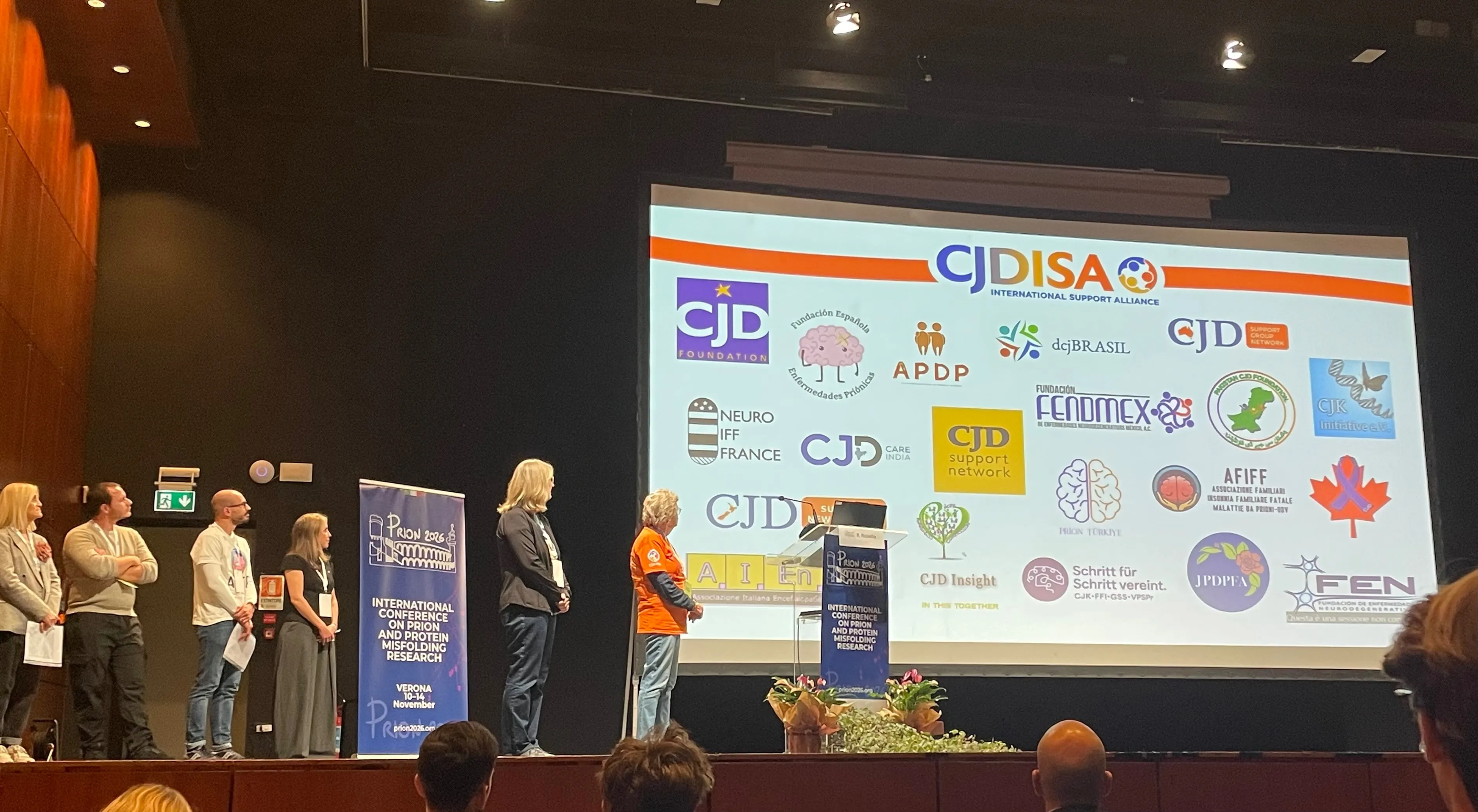
The CJD Support Network is a proud member of CJDISA, which exists to bring together family support and advocacy groups from across the world, as well as supporting people trying to set up groups in unrepresented countries. There are currently 20 member groups representing 18 countries. Deanna and Suzanne from CJDISA arranged a meeting room at a nearby hotel so we could meet and also welcome representatives from some of the major organisations currently running, or planning to run, clinical trials: the Broad Institute, Ionis, and Regeneron.
Multiple Shots on Goal
Eric Minikel from the Broad Institute is also part of a family affected by prion disease, and retrained along with his wife, Sonia Vallabh, to work on the search for a treatment. Sonia is a patient-scientist. Her family is affected by Fatal Familial Insomnia, and Sonia carries the genetic mutation. Given this background, Eric’s view point is always particularly relevant to family support groups. He joined us to give an update on the current state of research, and the mood of the moment.
Eric suggested that we are at a remarkable moment in prion disease research. For the first time, there is genuine hope that treatments might one day be able to delay or even prevent disease in people before symptoms begin. Researchers are increasingly united around the idea of lowering prion protein (PrP), the key protein involved in all forms of prion disease. While this progress is exciting, Eric was careful to note the continued need for patience. These treatments remain experimental, and it will take time to establish whether they are both safe and effective in people.
Encouragingly, several different research groups and companies are pursuing this goal at the same time. Programmes from Ionis, the Broad Institute, Regeneron and others are testing a range of approaches, giving us multiple shots on goal, as two representatives termed it. All of the attendees researcher emphasised that these efforts are not competing with one another; every advance helps move the field forward. Alongside drug development, there is also a growing recognition of the importance of observational studies that track disease progression and collect long-term data. These studies will be essential for interpreting future clinical trial results and ensuring that promising treatments can be tested as effectively as possible. While significant challenges remain, speakers described this as a historic and hopeful period for the prion disease community.
At the Conference Centre: Focus on Family Support Groups
Today was also International CJD Awareness Day. This means I was monitoring our social media posts, and replying to messages as well as taking in the conference. It was a real reminder of making the most of my time here, as I read the messages from people remembering their loved ones, as I was remembering my mother.
Here in Verona, it was also affecting and inspiring to be alongside family and friends from all over the world who have taken their experiences and turned them into action. The last session of the day was focused on family support organisations, with a focus on Italian groups.
Some examples of the different activities, and stages of development follow:
- The AFIFF association is an Italian association made up of family members affected by Fatal Familial Insomnia (FFI). Their goal is to raise awareness and support research and they have recently begun a Biobank in partnership with the Mario Negri IRCCS Institute. The aim is to collect biological samples to assist in the study of FFI. Their representatives spoke with passion about the need to find a way to feel they had some power, and to do something rather than simply wait. They also gave a compassionate description of the way some people feel they have to hide their link to FFI as a result of fear of judgement.
- To Be Duca was set up in Italy in 2025 by the children of Fabio Duchini who was lost to prion disease. Their organisation focuses on sports, creativity and well-being to raise awareness and funds for research. To date they have already contributed EU40,000. Their message: “A love in a million. TO BE DUCA is a message, an act of love, a promise.”
- A single person, Inge, in Belgium is beginning work to create a family support group.
- The first group in Pakistan was able to join us: the Pakistan CJD Foundation.
- Collaborations are happening between groups. The Spanish Fundacion Prionicas joined with AFIFF to climb Everest base camp and planted the flag of the Prion 2o26 conference there. You can read about this here (most browsers now have a translate button in the address bar).
I could go on. You can see all the groups who are part of the Alliance here.
CJDISA also recognised the friends and advisors of the Alliance, who are clinical experts from all over the world who offer their support, for free to Alliance members. Two of our Trustees, Richard and Simon, are part of this group. The advisers in the room were invited to stand and accept applause for their efforts.
Family Support Groups and Research
We then focused on the ways the different groups support research. We were all invited to give a brief explanation to the audience from the stage.
My comments were as follows, with perhaps some slight changes in the moment:
Hello, I’m Catherine and I am the National Coordinator of the CJD Support Network in the UK. Thank you to the organising committee, and to my charity trustees for the opportunity to be at this incredible event.
Of course we update our community on current research via our socials, website and newsletters. I am currently going back each evening and posting updates from the conference about camels and bank voles and all sorts of things.
However, we also offer research grants funded by our incredible community. These funds mainly come from In Memory collections, fundraising events and general donations.
At the conference I have heard several references to the need to speed up the process of diagnosis. Most recently we have awarded a £25,000 grant to fund research to create an effective AI model to facilitate fast and accurate on site diagnosis atlocal hospitals.
Another £5,000 grant was awarded to a specialist prion disease nurse to research how best to support children affected by young people, and create appropriate resources for them.
Finally, we have extended a grant examining the use of a targeted therapy session to support people living with the risk of prion disease.
We are grateful both to our community and the researchers concerned for making these projects possible.
I welcome explaining more her the remaining days of Prion 2026 to anyone who has questions. Whilst here, may I offer a sincere thank you for your day to day efforts to help us all understand prion disease, and provide hope for the future. Thank you.
After each group had reported, we ended the session by watching the video created for a previous awareness day which included representatives from many different languages united in a simple message: Globally United for Prion Disease. Finally, the attendees were invited to join us in making this statement.
The session ended and afterwards there were many photos taken and new friendships confirmed, and contact details swapped. The conference continues tomorrow.
You can visit the conference website here.
Details on our Research Grants are available here.